
Polyurea vs. TPO & EPDM RV Roofing
Most RV owners know the words TPO, EPDM or “rubber roof.” Far fewer understand how differently those roofs are constructed compared with a professionally sprayed polyurea system.
Traditional RV roofs generally use a flexible sheet membrane adhered over the roof deck. Highroad's Permanent 100 and Extreme 200 completely remove the old exterior roofing, expose the deck for inspection and build a new ArmorFlex UV sprayed roof in place.
Both approaches can keep water out. They just build the roof very differently.
TPO and EPDM Are Established RV Roofing Materials.
They make practical sense for mass production. That does not mean they are the only choice when you are replacing one roof on an RV you already own.
Thermoplastic Polyolefin
A flexible thermoplastic roofing material commonly supplied in large rolls and installed as a single-ply roof membrane.
Ethylene Propylene Diene Monomer
A flexible synthetic-rubber roofing material with a long history in RV and commercial roofing applications.
TPO and EPDM are not “bad roofs.” They are established systems built around a different construction method.
They Fit the Priorities of Mass Production.
RV manufacturers have to balance material cost, weight, production speed, repeatability, material availability and required performance across hundreds or thousands of units.
- Lightweight construction
- Large rolls that can cover an RV roof efficiently
- Adhesive-based installation
- Fast, repeatable production-line methods
- Established sealant and repair systems
- Widely available materials and service familiarity
The factory is not trying to build the most expensive roof possible. It is balancing cost, weight, speed and required performance.
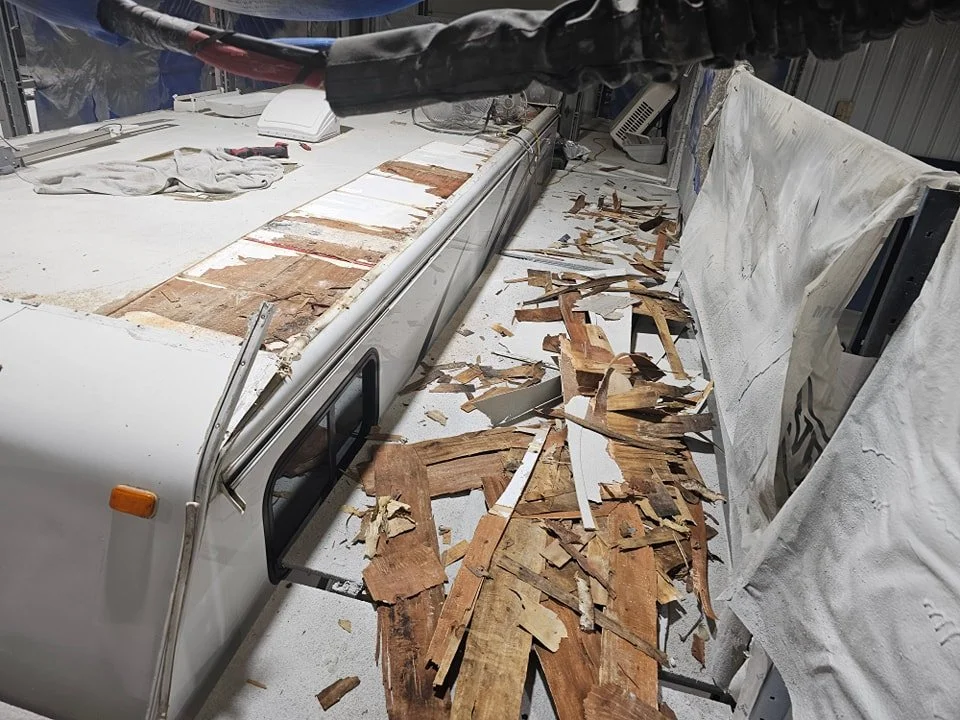
The Best Decision for an Assembly Line Isn't Necessarily the Decision You Have to Make Later.
When Highroad replaces your roof, we're not building hundreds of RVs. We're building one roof — your roof.
Your RV was built to a factory production specification. Your replacement roof doesn't have to be.
Inspect What's Underneath
A complete replacement can expose the deck so hidden deterioration can be found before the new roof is finished.
Choose the Material Build
Permanent 100 and Extreme 200 specify a target ArmorFlex UV film build instead of simply installing another sheet.
Choose for Long-Term Ownership
The replacement owner can prioritize durability, warranty and future ownership differently than the original factory did.
Sheet Membrane vs. Sprayed Roof.
These are not two brands of the same roof. They are two substantially different ways of constructing the exterior roofing system.
The Roof Begins With a Flexible Sheet.
- Roof deck prepared for the membrane system
- Compatible bonding adhesive applied
- Flexible sheet installed across the roof
- Rooftop components reinstalled
- Edges and penetrations detailed with compatible tapes, sealants, moldings and fasteners as required
The Roof Is Built in Place With ArmorFlex UV.
- Existing exterior roofing completely removed
- Roof deck exposed and inspected
- Required decking repairs completed
- Edges, transitions and penetrations prepared
- ArmorFlex UV professionally spray-applied with heated two-component high-pressure equipment
- Specified 100- or 200-mil target film build
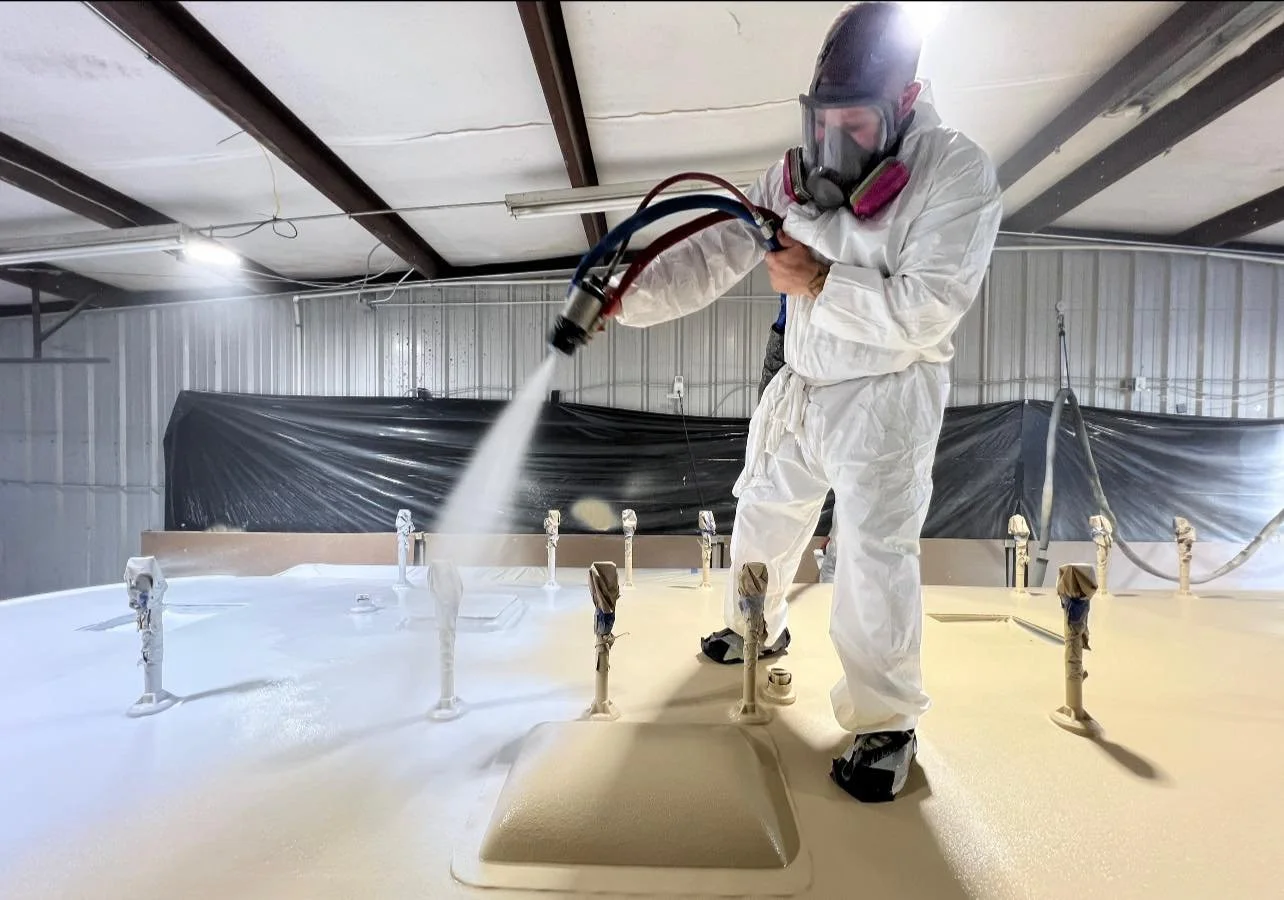
ArmorFlex UV Is Not Painted, Brushed or Rolled Onto the Roof.
Highroad uses ArmorThane's proprietary ArmorFlex UV aliphatic polyurea with heated, two-component high-pressure spray equipment.
The two material components meet and mix at the spray gun, then cure rapidly after application to form the exterior roofing layer.
Traditional RV Membrane Thickness Varies. Highroad Specifies Its Target Build.
A current factory TPO example is 35 mils. Other RV membrane products use different thicknesses, so Highroad does not claim every factory roof is 35 mils.
35 Mils
35Approximately 0.035 inch
100-Mil Target
100Approximately 0.100 inch target ArmorFlex UV film build
25-Year Transferable Highroad Warranty
200-Mil Target
200Approximately 0.200 inch target ArmorFlex UV film build
Lifetime Transferable Highroad Warranty
Important: Permanent 100 targets about 2.86× the film thickness of that 35-mil example, and Extreme 200 about 5.71×. Those are thickness comparisons only — not claims that either roof is proportionally stronger.
The Finished Surface Isn't the Whole Job.
Rotten decking, soft areas, water intrusion, delamination and previous repairs can be hidden below the existing exterior roofing.
Covering damaged wood doesn't make it a new roof.
Permanent 100 & Extreme 200
Both require complete tear-off so the deck can be exposed, inspected and repaired as required before ArmorFlex UV is installed.
- Existing exterior roofing removed
- Substrate made visible
- Condition evaluated
- Damage addressed where required
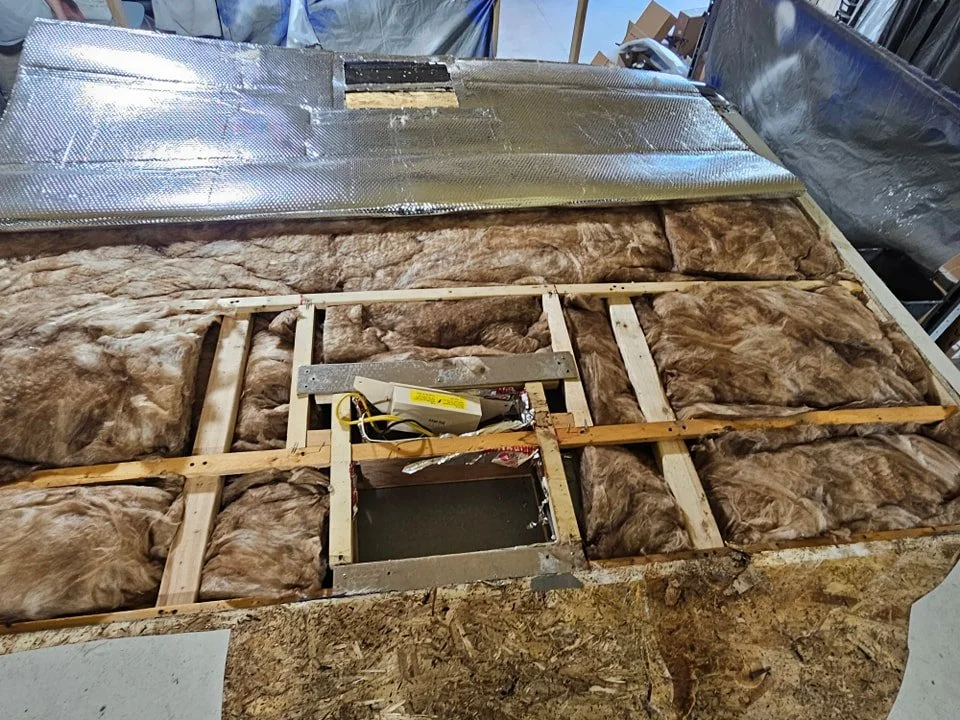
Most Roofs Have More Going On Than the Big Flat Surface.
Air conditioners, vents, skylights, plumbing penetrations, fans, antennas, solar equipment, roof edges and front/rear transitions all have to be detailed correctly.
Traditional membrane roofs commonly use compatible butyl tape, lap sealant, flashing, moldings and mechanical fastening around these areas. Those materials perform an important job and should be inspected and maintained as appropriate.
Highroad uses a professionally sprayed roof and prepares applicable penetrations and transitions as part of the installation. Rooftop components and physical damage should still be inspected over time.
Punctures, Tears and Physical Damage Still Matter.
Modern TPO and EPDM products can offer flexibility, tear resistance, puncture resistance, UV resistance and established repair methods. Highroad does not describe conventional membranes as fragile simply because they are thinner.
Tree Limbs & Sharp Objects
Any roof can be damaged by mechanical impact or sharp objects.
Roof Work & New Equipment
Improper installation or later modifications can damage roofing around new penetrations.
Repairability Matters
TPO, EPDM and ArmorFlex UV all have repair approaches when properly evaluated and repaired with compatible methods.
Different Roofing Materials Can Use Different UV Strategies.
Modern TPO and EPDM roofing products can be engineered for long-term outdoor exposure. Highroad chose ArmorFlex UV because its aliphatic polyurea chemistry is designed for UV stability throughout the ArmorFlex UV material itself.
For Arizona, Highroad wanted UV-resistant chemistry in the roofing material — not just a good-looking white surface.
“Maintenance-Free” Is Too Broad a Promise for Any RV Roof.
A better question is what type of inspection and maintenance the roof construction requires over time.
Established Membrane Maintenance
Depending on the roof system, maintenance can include inspection of roof edges, penetrations and lap sealants; repair of physical damage; cleaning; and care of rooftop equipment.
Different Construction, Still Worth Inspecting
ArmorFlex UV eliminates the traditional rolled sheet across the main roof field. Air conditioners, vents, fans, skylights, solar equipment, mechanical attachments and physical damage still deserve periodic inspection.
Don't Compare the Number of Years Alone.
Different TPO and EPDM manufacturers offer different material warranties, limitations, exclusions, transfer provisions and labor coverage.
A warranty duration only tells part of the story. Read the written terms and understand who actually stands behind the completed roof.
Highroad Complete-Replacement Warranties
Permanent 100 — 25-Year Transferable Highroad Warranty
Extreme 200 — Lifetime Transferable Highroad Warranty
ArmorThane provides the ArmorFlex UV material technology. Highroad performs the inspection, tear-off, preparation, installation, quality control and completed-roof warranty.
All Highroad warranties are subject to the complete written terms and exclusions.
There Isn't One Answer for Every RV.
Highroad's point is not that every owner should buy the same roof. The point is to understand the construction before deciding.
Traditional TPO / EPDM May Fit If...
- You want conventional factory-style construction
- Initial project cost is a primary concern
- You prefer a system widely familiar to RV service facilities
- You are comfortable with traditional membrane and sealant practices
Permanent 100 May Fit If...
- Your roof needs complete replacement
- You want the deck fully exposed and evaluated
- You want a 100-mil target ArmorFlex UV build
- You want a 25-year transferable Highroad warranty
Extreme 200 May Fit If...
- You want Highroad's maximum material build
- You are planning for long-term ownership
- You want a 200-mil target ArmorFlex UV build
- You want a lifetime transferable Highroad warranty
What If the Existing Roof Is Still Sound?
Restore is a different option for qualifying roofs that do not need unnecessary complete tear-off. Highroad inspects the existing roof first and only offers Restore when the existing roof is suitable.
EXPLORE RESTORE14 Questions to Ask Before Choosing an RV Roof.
These questions make it much easier to compare competing proposals on an apples-to-apples basis.
Ask for the actual product name, not only the general material category.
Those are different scopes of work.
Know whether you are buying restoration or replacement.
Ask whether the substrate will actually be visible.
Understand how repairs are handled and priced.
Ask for the answer in mils when comparing sprayed systems.
“Polyurea” describes a category, not one universal formula.
Ask how the material is designed to handle exterior UV exposure.
Is it inherent in the roofing material or supplied by a separate surface layer?
Ask specifically about A/Cs, vents, skylights, edges and transitions.
A serious contractor should be able to explain long-term care.
Manufacturer material warranty and contractor completed-roof warranty are not always the same thing.
Transferability can matter if you sell the RV later.
Read the actual written terms, not only the headline duration.
Quick Answers.
Is polyurea automatically better than TPO?
No. They are different roof constructions. TPO is an established lightweight single-ply roofing material commonly used in RV production. Highroad's ArmorFlex UV systems are professionally sprayed aftermarket roofs. Compare construction, preparation, thickness, UV strategy, maintenance and warranty.
Is EPDM still a legitimate RV roofing material?
Yes. EPDM has a long history in RV and commercial roofing. Highroad offers sprayed polyurea as a different replacement approach rather than claiming EPDM has no legitimate use.
Are all TPO RV roofs 35 mils thick?
No. Thickness varies by manufacturer and product. Highroad uses 35 mils as a current factory example, not as a claim about every TPO roof.
Is 100 mil ArmorFlex UV 2.86 times stronger than 35-mil TPO?
No. It is approximately 2.86 times the film thickness of that 35-mil example. Different materials have different physical properties, so thickness cannot be converted directly into proportional strength.
Does a sprayed ArmorFlex UV roof have a rolled sheet seam across the roof field?
No. ArmorFlex UV is sprayed continuously across the prepared roof field rather than installed as a separate rolled sheet. The RV still has edges, transitions, penetrations and rooftop components that require professional detailing.
Can TPO or EPDM be repaired?
Yes. Traditional roofing manufacturers provide established membrane patches, tapes, sealants and repair systems. Repairability is a legitimate advantage of widely used conventional roof systems.
Can ArmorFlex UV be repaired if physically damaged?
Yes. Compatible professional repair procedures can be used when needed. No RV roofing system should be represented as impossible to damage.
Who provides Highroad's Permanent 100 and Extreme 200 warranties?
Highroad RV Roofing provides the completed-roof warranty, subject to the written terms. ArmorThane supplies the ArmorFlex UV material technology and technical support.
If the Roof Has to Be Replaced, Compare Your Options First.
You can replace a traditional sheet roof with another traditional sheet roof. Or you can evaluate a completely different roof construction.
Your RV was built to a factory production specification. Your replacement roof doesn't have to be.