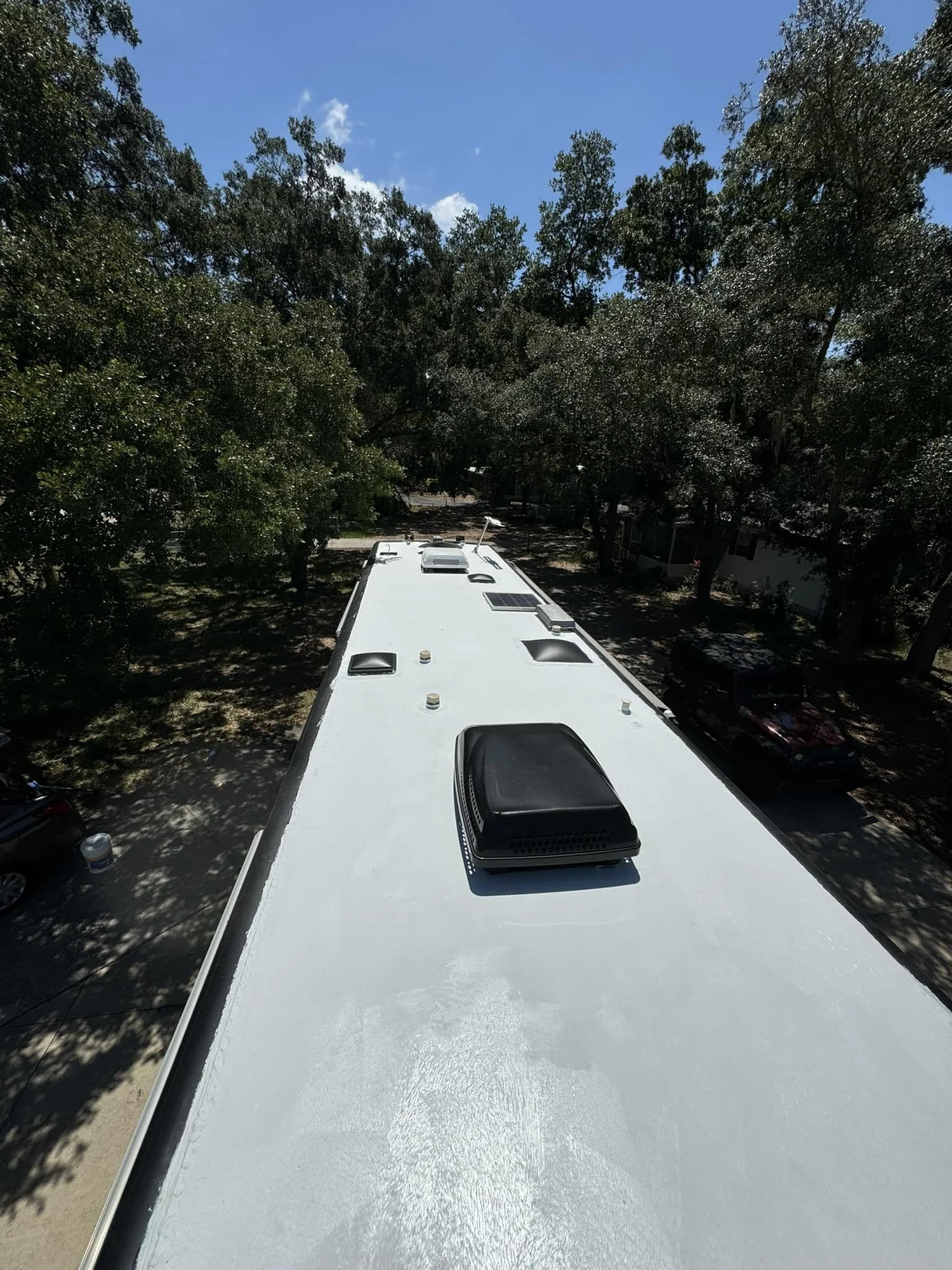
A Better RV Roof for Arizona Heat.
Arizona doesn't treat an RV roof gently. Highroad approaches the problem from both sides of the roof assembly.
Reduce Unnecessary Solar Heat Absorption.
A white aliphatic polyurea exterior designed for demanding outdoor exposure while helping reduce solar energy absorbed at the roof surface.
Add Real Thermal Resistance.
Closed-cell spray polyurethane insulation can add measurable resistance to conductive heat transfer through qualifying roof assemblies.
Reflect more solar energy outside. Resist more heat transfer underneath.
Arizona Is a Benchmark Environment for Testing Outdoor Materials.
The Arizona desert is used by the coatings and materials industries because its combination of intense sunlight, high UV exposure, extreme heat, low humidity and large temperature swings can accelerate outdoor weathering.
That makes Arizona directly relevant to an RV roof that may spend years sitting outside.
Arizona doesn't give an RV roof much of an off-season.
See the published Arizona benchmark UV and heat data
Published benchmark data used in the Highroad technical blueprint show central Arizona at approximately 333.5 MJ/m² of annual UV radiant exposure versus approximately 280.0 MJ/m² for the southern Florida benchmark — roughly 19% more at those specific benchmark sites.
Q-Lab also reports that summer air temperatures at its Arizona desert exposure facility can reach about 115°F and that dark test specimens may exceed about 160°F.
Those specimen temperatures are examples from a materials-weathering environment. They are not a claim that a Highroad RV roof will reach 160°F.
There Isn't Just One Kind of Roof Heat.
A reflective roof and insulation solve different parts of the heat problem.
Exterior question: How much solar energy does the roof absorb? Insulation question: How easily can heat move through the roof assembly?
Roof Color Matters — But Color Alone Doesn't Tell the Whole Story.
The U.S. Department of Energy points to two important properties: how much solar energy a roof reflects, and how effectively it can release heat it does absorb.
Solar Reflectance
How much incoming solar energy the roof reflects instead of absorbing. More reflected energy means less of that energy becomes heat in the roof.
Thermal Emittance
How effectively the surface releases heat it has absorbed. A roof can be reflective and still differ in how well it sheds heat.
What is Solar Reflectance Index, or SRI?
SRI is a calculated indicator that considers both solar reflectance and thermal emittance. It is useful for comparing how hot different surfaces are expected to become under standardized conditions.
Highroad does not assign an SRI value to ArmorFlex UV without product-specific testing that supports one.
Aluminum Doesn't Automatically Mean Cooler.
A metallic or aluminum-colored roof can reflect substantial solar energy, but reflectance is only part of the equation. Thermal emittance also matters.
U.S. Department of Energy cool-roof guidance notes that some unpainted metal surfaces can have relatively low thermal emittance. That means a surface may reflect sunlight well while being less effective at releasing the heat it still absorbs.
Look at the material properties — not just the appearance.
Ask Better Questions
- What is the solar reflectance?
- What is the thermal emittance?
- How does the material perform after outdoor aging?
- What is the actual roofing chemistry?
- Is there insulation underneath the roof?
Highroad does not claim white ArmorFlex UV is definitively cooler than a specific competing roof without comparable product-specific test data.
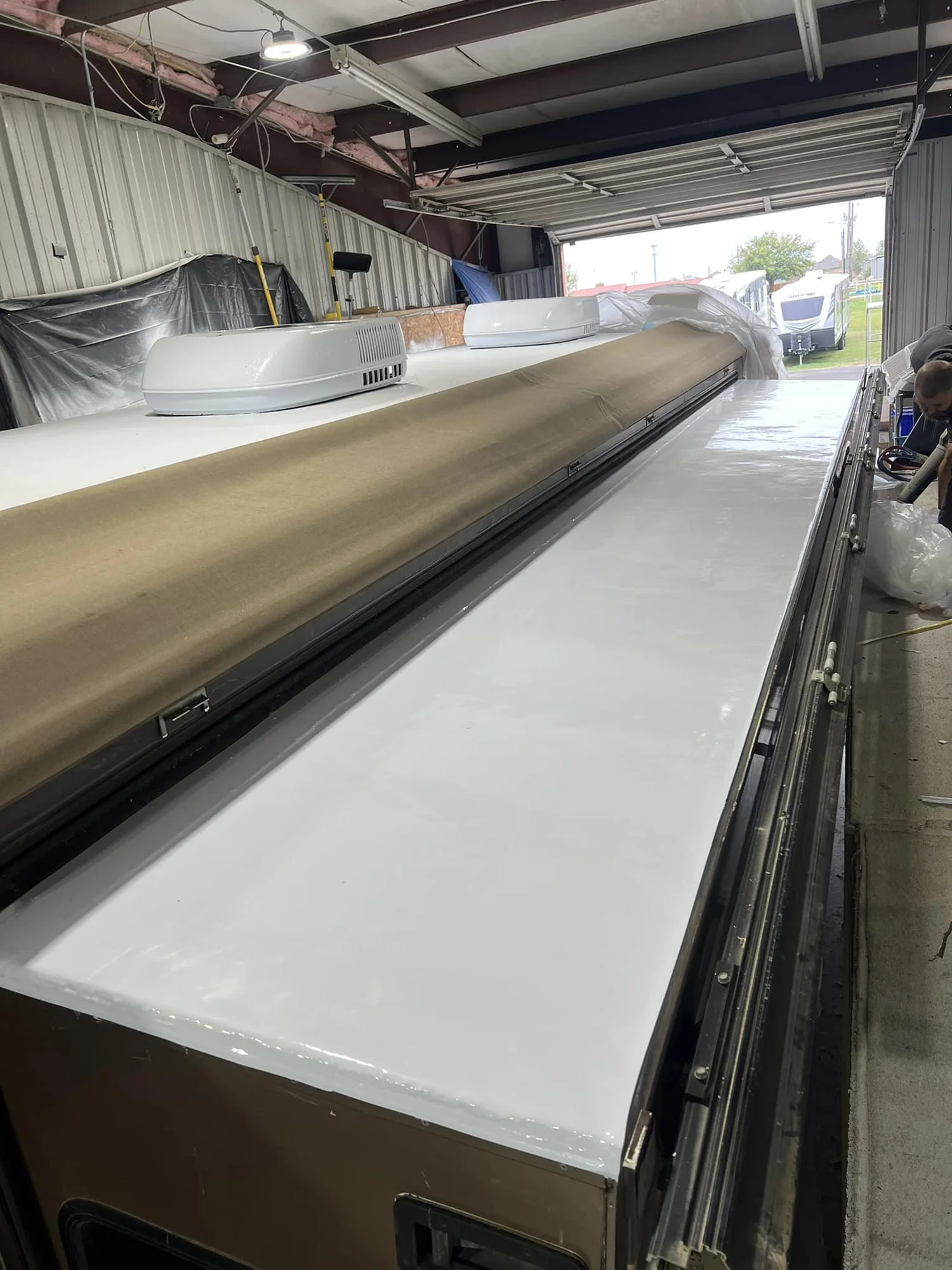
Why Highroad Uses White ArmorFlex UV.
The exterior roof has to do more than address heat. It also has to keep water out, tolerate prolonged UV exposure, remain flexible as the RV moves and protect the roof in a demanding outdoor environment.
ArmorFlex UV is an aliphatic polyurea. Its UV-resistant chemistry exists throughout the applied ArmorFlex UV material rather than relying only on a separate UV-resistant surface finish.
Its white exterior also helps reduce unnecessary solar-energy absorption.
The best heat to insulate against is heat you never absorb in the first place.
Reflective Roofing Is Not Insulation.
A cooler exterior surface doesn't replace R-value, and insulation does not replace a reflective exterior.
White ArmorFlex UV
Works primarily at the exterior roof surface by helping reduce solar energy absorbed by the roof.
ArmorFoam
Works inside qualifying roof cavities by adding resistance to conductive heat transfer through the roof assembly.
Two different layers. Two different jobs.
Why ArmorThane ArmorFoam?
RV roofs do not have room for a deep attic. On qualifying complete roof-reconstruction projects, Highroad can evaluate ArmorThane ArmorFoam closed-cell spray polyurethane foam for accessible roof cavities.
ArmorThane publishes an aged insulation value of approximately R-6.5 per inch through the foam itself.
These are insulation values through the foam layer itself. They are not claims that the entire RV roof assembly becomes R-6.5 or R-13.
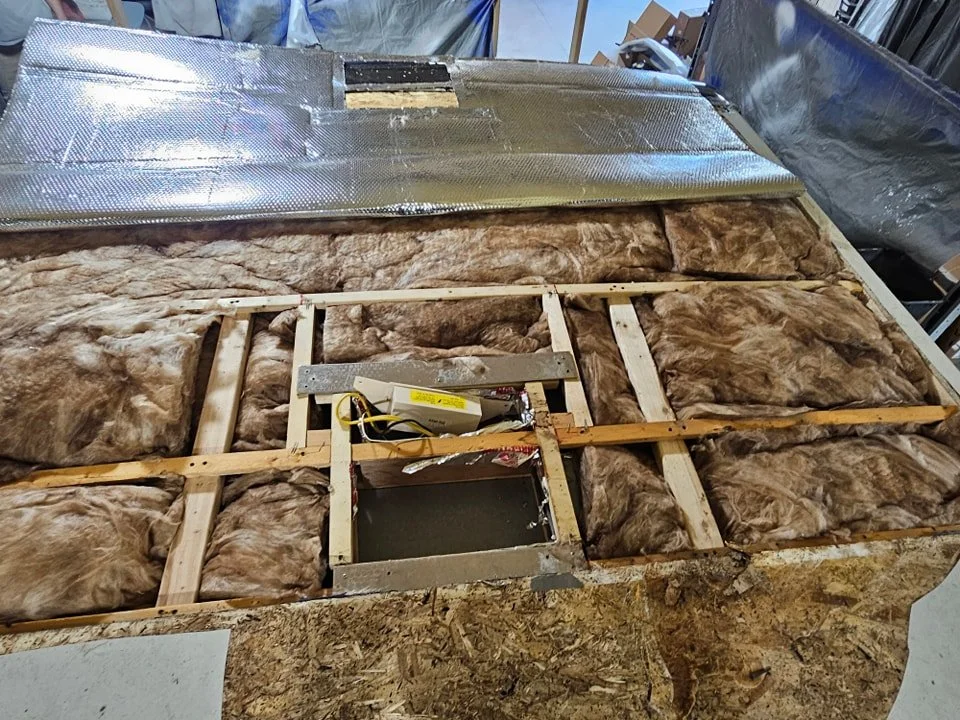
Why isn't the whole roof automatically R-13 with 2 inches of foam?
The complete roof also includes framing, decking, ceiling materials, penetrations, air spaces and other components. Framing and penetrations can create thermal bridges. The published R-value applies to the foam layer itself.
Highroad's Thermal Roof Upgrade Uses Two Materials for Two Different Jobs.
Exterior sprayed polyurea roofing that helps reduce solar heat absorption.
Closed-cell insulation that adds measurable resistance to conductive heat transfer.
Don't rely on one layer to solve two different problems.
Roof Replacement May Be the Best Time to Improve the Insulation Under It.
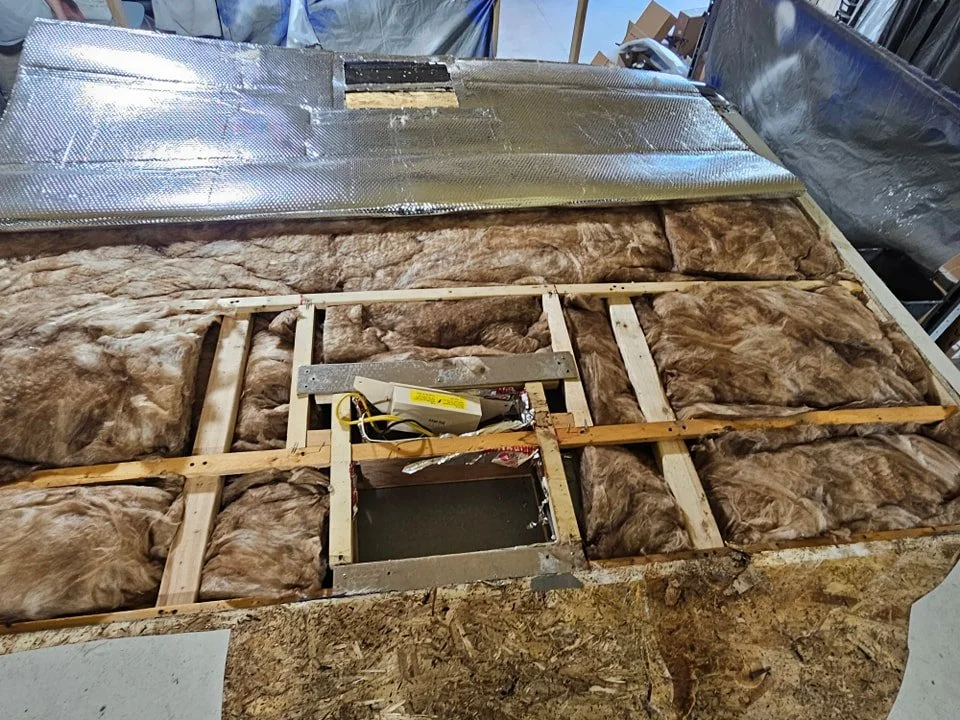
Permanent 100 and Extreme 200 involve complete roof tear-off. Depending on the RV's construction, that can create access to areas that are normally hidden.
- Examine existing insulation
- Identify poorly insulated or missing areas
- Determine available cavity depth
- Evaluate whether ArmorFoam is appropriate
- Reconstruct the roof over the improved insulation assembly
If the roof is already open, that's the logical time to evaluate what's underneath it.
Normally Not Available
Restore retains a qualifying existing roof and generally does not open the roof cavity.
May Be Available
ArmorFoam may be available on qualifying RVs where roof construction provides appropriate access and cavity depth.
May Be Available
ArmorFoam may be available on qualifying RVs where roof construction provides appropriate access and cavity depth.
Don't Confuse a Radiant Barrier With R-Value.
They address heat differently, and one is not automatically a substitute for the other.
Radiant Barrier
Primarily intended to reduce radiant heat transfer. Performance depends on the reflective surface, orientation, installation configuration and proper adjacent air space.
ArmorFoam Closed-Cell Insulation
Adds measurable resistance to conductive heat transfer. ArmorThane publishes an aged insulation value of about R-6.5 per inch through the foam itself.
A properly designed radiant barrier can be useful. ArmorFoam adds actual R-value.
We'll Tell You What We're Installing.
- Insulation: ArmorThane ArmorFoam closed-cell spray polyurethane foam
- Published aged R-value: approximately R-6.5 per inch through the foam
- Installed thickness: depends on available cavity depth and RV construction
- White ArmorFlex UV: helps reduce solar energy absorbed at the exterior roof surface
- ArmorFoam: adds thermal resistance to help slow conductive heat transfer
What Highroad Will Not Promise Without Testing
- Your RV will be a specific number of degrees cooler
- Your air conditioners will run a specific percentage less
- You will save a specific amount of electricity
- Two inches of foam eliminates nearly all heat gain
The roof is only one part of an RV's thermal envelope. Windows, walls, slide-outs, air leakage, floor insulation, shade, appliances and A/C condition all matter too.
Quick Answers.
Why is Arizona especially hard on RV roofs?
Arizona is a recognized benchmark environment for outdoor material weathering because of its intense solar exposure, high UV, high temperatures, low humidity and large temperature fluctuations.
Does a white RV roof really help?
A white roof can reduce solar-energy absorption when it has appropriate solar-reflectance properties. Exact performance depends on the tested properties of the specific roofing material.
Is aluminum-colored roofing automatically cooler than white?
No. Solar reflectance and thermal emittance both matter. Appearance alone does not determine which roof will maintain a lower surface temperature.
Is reflective roofing the same as insulation?
No. Reflective roofing helps manage incoming solar energy at the exterior. Insulation adds resistance to heat flowing through the roof assembly.
What is the R-value of ArmorFoam?
ArmorThane publishes an aged R-value of approximately R-6.5 per inch through the foam itself. Two inches is approximately R-13 through the foam itself, not necessarily through the entire roof assembly.
Can every RV receive 2 inches of ArmorFoam?
No. Available thickness depends on the roof construction and cavity depth of the individual RV.
Can ArmorFoam be added with Restore?
Normally no. Restore retains the qualifying existing roof and generally does not open the roof cavity.
Can horse trailers and cargo trailers receive the Thermal Roof Upgrade?
Potentially, yes. Highroad can evaluate qualifying horse trailers, living-quarter horse trailers, cargo trailers, enclosed trailers, toy haulers and specialty trailers. Eligibility depends on roof construction and available cavity access.
Don't Just Replace the Roof. Improve the Roof Assembly.
White ArmorFlex UV outside. Optional ArmorFoam underneath. Complete tear-off and deck inspection with Permanent 100 or Extreme 200.
Reflect more solar energy outside. Resist more heat transfer underneath.